Three Things Before the Menu: Radish, Butter, Salt
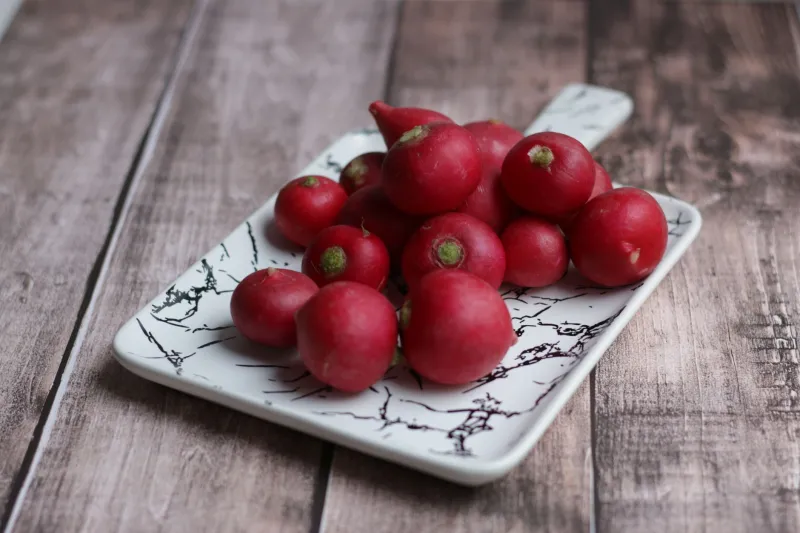
The first thing to arrive at a good bistro table is rarely the menu. It is a small plate, pushed across the cloth without ceremony: a handful of radishes, leaves still attached, a curl of butter, a little dish of salt. Nobody explains it. Nobody needs to. You pick one up by the stem, dip, salt, crunch, and by the time the carte appears you are already settled, already looked after, already in the mood for something good.
In November, when the light goes early and the walk to the restaurant is a cold one, that plate does more work than it is usually given credit for. It is the quietest invitation a bistro can make, and one of the most revealing.
An Opening With Nothing to Prove
A long menu is a promise. A plate of radishes is a demonstration. There is nowhere to hide in it: the vegetables must be fresh and firm, the butter must be at the right temperature, the salt must be worth its place. No sauce, no garnish, no technique to admire. Just three things, arranged with enough care that the guest feels the care rather than sees it.
That is why the radish plate reads as confidence. A kitchen that sends out something this plain is saying, in effect, that it trusts its suppliers and its own judgement. A kitchen that skips it, or replaces it with something fussier, is often saying something else: that it would rather impress you than settle you.
What the French Understood
The habit comes from France, where radis beurre is less a recipe than a reflex. In spring, markets fill with long pink breakfast radishes and the default treatment is the one above: cold, crisp, salted, buttered. The butter is not a dip in the American sense, and the salt is not a seasoning afterthought. They are the point. Fat softens the radish's peppery edge, salt lifts its sweetness, and the crunch keeps the whole thing lively on the tongue.
What the French bistro grasped long ago is that this is not really about radishes. It is about pace. A small, sharp, salty thing at the start of a meal wakes the appetite without filling it, and gives a table something to do with its hands while it decides what to order. Ordered from a menu, it would cost a few pounds and be overlooked. Given freely, it changes the temperature of the room.
Britain Has the Right Radishes for This
We are not short of good radishes on this side of the Channel, and the winter ones are arguably better suited to a November table than the delicate spring varieties. At this time of year, growers at British farmers' markets are bringing in the robust sorts: long red-and-white French Breakfast types, white icicle radishes, the round black Spanish radish with its fierce, almost horseradish heat, and the striking watermelon radish, pale outside and shocking pink within.
The winter radishes need a little more thought. The black one in particular is too assertive to eat like a breakfast radish, and wants slicing thinly, almost shaved, so the salt and butter can get at it. The watermelon radish is milder and rewards being cut into rounds so that the colour shows. The icicle is the quiet one, all crunch and very little heat, which makes it a good choice for a table where not everyone loves a peppery bite.
The Butter Question and the Salt Question
Use salted butter and bring it out of the fridge well before you need it. Cold butter tears the radish and refuses to coat it. An hour on the counter is usually enough; in a warm kitchen, less. If you prefer unsalted butter for control, fine, but then the salt at the table needs to be proper flaky sea salt rather than a fine pour, so that each pinch lands as a small, bright crunch rather than disappearing into the fat.
There is a case for serving the salt in a tiny dish rather than sprinkling it in the kitchen. It gives the guest something to do, and it lets them choose how hard to lean into the pepperiness. It also looks right: a little white dish, a small knife, a plate of radishes with their green tops still on. The tops are not there for decoration. They are the handle.
Why It Costs So Little and Says So Much
A bunch of radishes is one of the cheapest things a kitchen can buy. The butter is already in the fridge. The salt is already on the shelf. There is no cooking, no plating skill beyond a certain neatness, no waste to speak of. In cost terms, the plate is close to negligible.
In hospitality terms, it is enormous. It arrives before anything has been asked for, which is the definition of generosity. It gives the table something to share in the first two minutes, which is when a group is most awkward. It slows the ordering down, which almost always improves it. And it sets a tone: this is a place that begins with care rather than with a sales pitch.
Doing It at Home
This is not a restaurant trick that falls apart in a domestic kitchen. Buy radishes with their leaves on if you can, and keep them cold and damp until the moment you need them. Trim the leaves to a short stub, leave the root end intact. Put out a dish of good salted butter, a small bowl of flaky salt, and, if you like, a few slices of bread. That is the whole thing.
It works best as the very first thing on the table, before the wine is poured and before anyone has asked what is for supper. It gives a November evening a beginning, which is more than most meals manage.
And if you are the sort of person who reads a bistro by its small gestures rather than its headlines, you will already know what to look for. The radish plate will tell you most of what you need to know before the menu has even been opened.